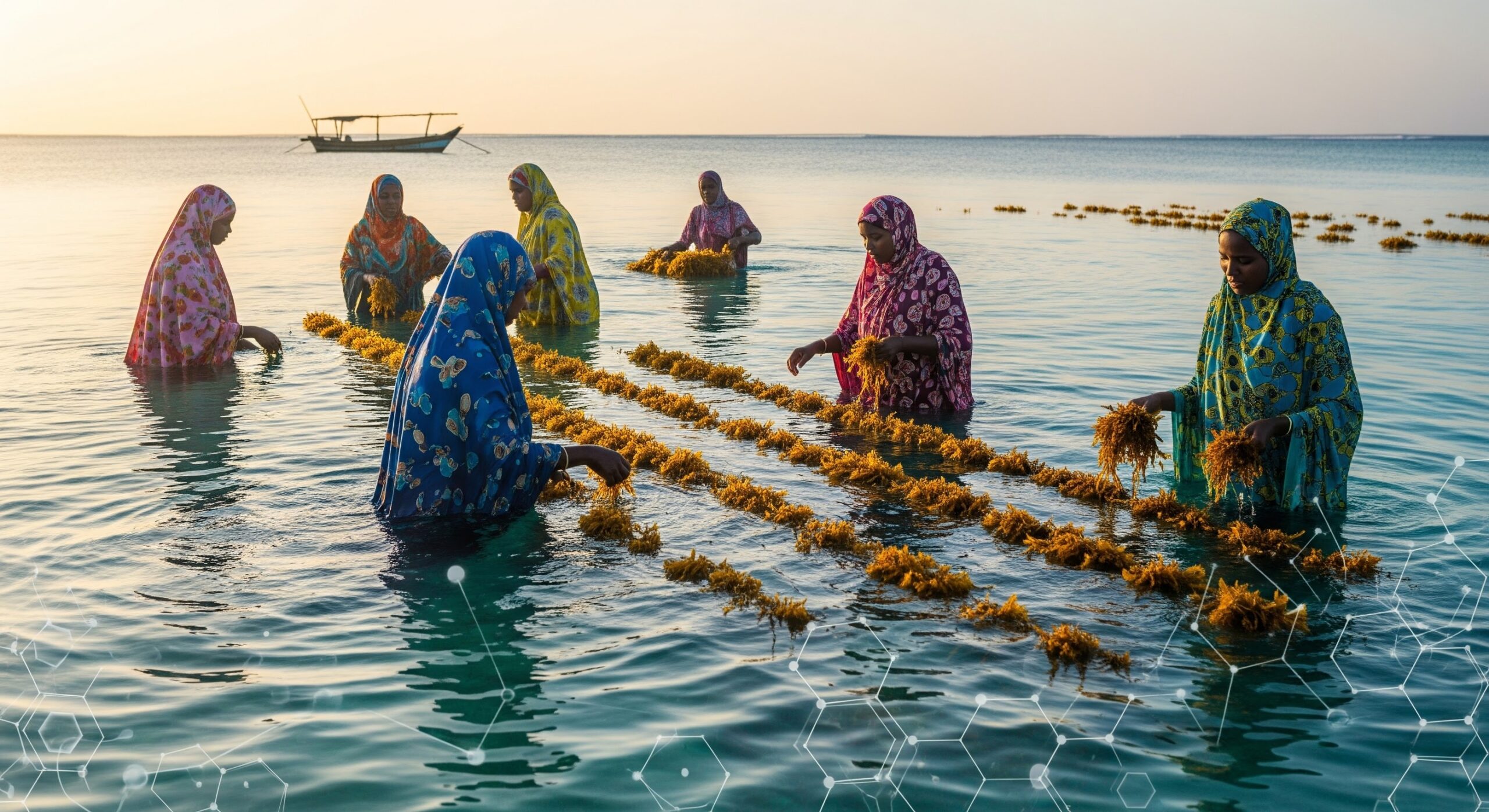
Seaweed farming in Kibuyuni and Mkwiro in Kwale County Kenya.The Image is AI generated.
Global demand for seaweed is booming, but women farmers on Kenya’s coast are being left out of the data and digital systems that determine access to markets, income and opportunity.
Beneath the clear blue waters of the Indian Ocean near Mkwiro Village on Kenya’s southern coast, thousands of ropes sway gently with the tides. Attached to them are clusters of seaweed, growing slowly in the warm, shallow lagoon.
To an outsider, the floating lines may look like simple marine farms. But for the women of Mkwiro, they represent survival. For Mwanamkuu Bakari, each rope means school fees, hospital bills, and daily meals for her family.
Beyond the tides, hundreds of women like Mwanamkuu are being left out of the digital technologies reshaping global agriculture and aquaculture. This shift presents a paradox: the more visible the seaweed industry becomes to international markets, the more invisible the women who sustain it risk becoming.
Seaweed farming arrived in Mkwiro as an alternative livelihood when fish stocks declined, and climate pressures intensified along Kenya’s coast. Unlike fishing, it requires minimal equipment and can be managed close to shore, making it particularly accessible to women.
Today, the shallow waters off Mkwiro host a patchwork of small farms tended mostly by women. In total, 82 women and 12 men work on the farms, their days shaped by the rhythm of the tides.
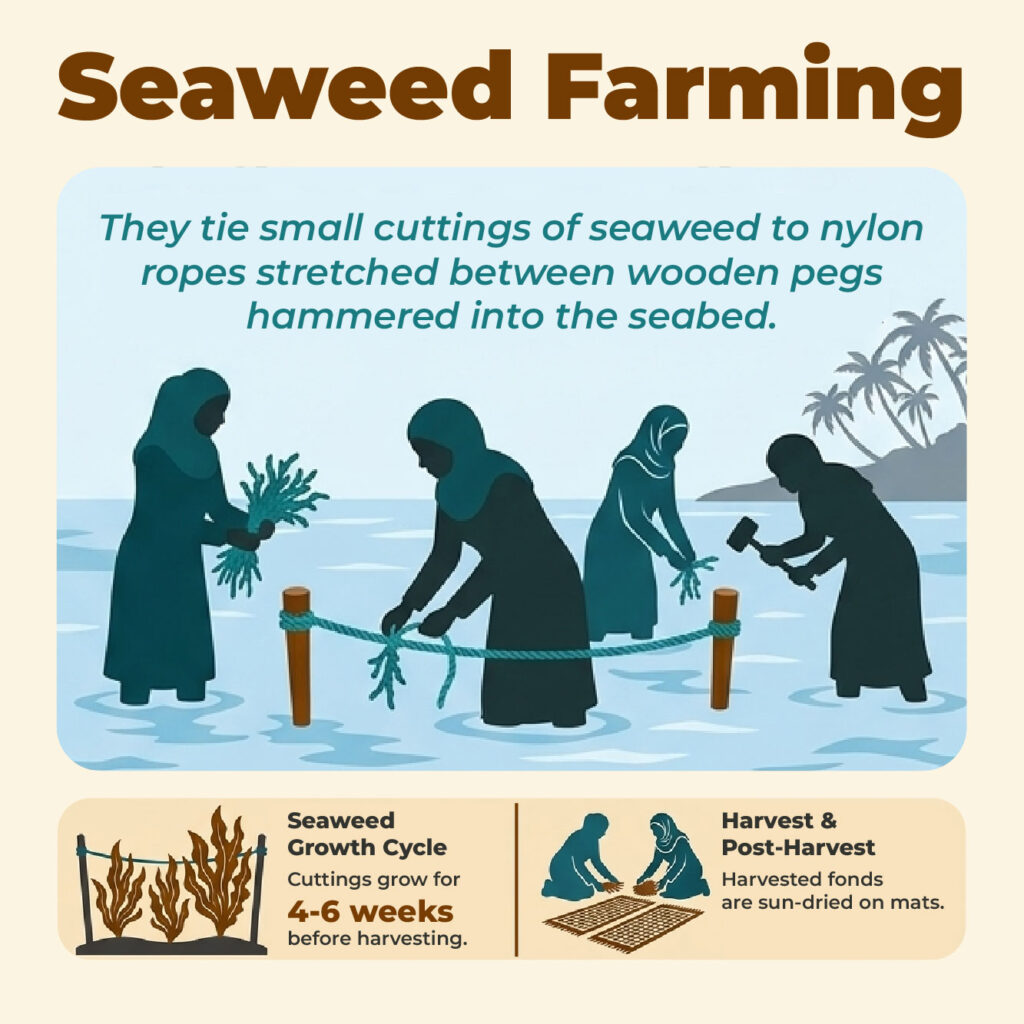
At low tide, farmers wade into the lagoon and tie small cuttings of seaweed to nylon ropes stretched between wooden pegs hammered into the seabed. Over several weeks, the plants grow into thick clusters ready for harvest.
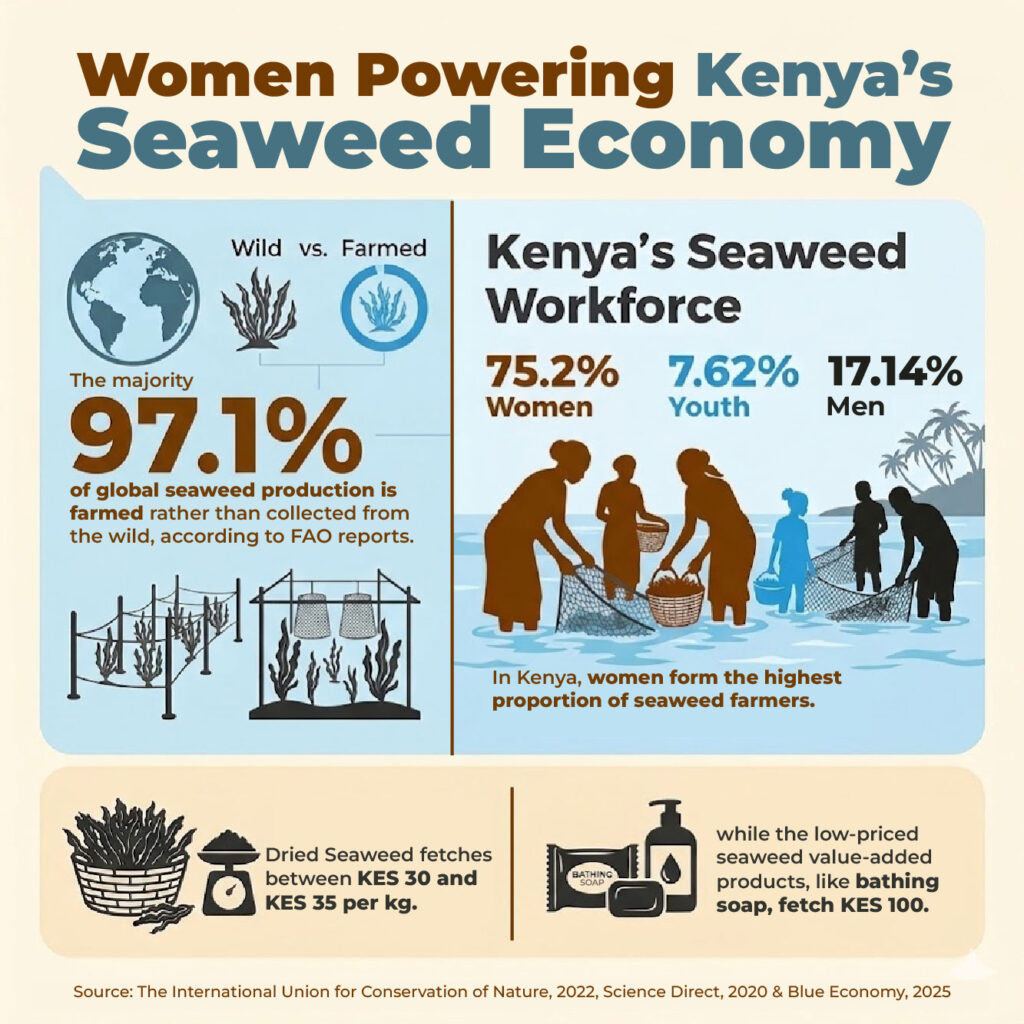
The work is physically demanding. Farmers lift heavy ropes, wade long distances in water, and dry the harvest under the sun. Mwanamkuu buys seedlings at about Sh106 per bag, along with 600 wooden pegs for a standard plot. When markets are stable, dried seaweed fetches between Sh16 and Sh30 per kilo, but stability is never guaranteed.
“I have about one tonne of seaweed at home that hasn’t found a buyer,” Mwanamkuu says. Her voice carries both determination and exhaustion.
“Right now, I have no money. That seaweed is my only source of income.”
Her struggle to find buyers and earn money from seaweed stands in stark contrast to the scale of the global seaweed trade. In 2023 alone, more than 800,000 tonnes of seaweed products were exported worldwide, valued at over US$3 billion (Sh388 billion), according to the Food and Agriculture Organization (FAO).
Women like Mwanamkuu form the backbone of seaweed farming, making up 75% of farmers in Kibuyuni, but their work is rarely reflected in the systems that shape global markets.
Across the industry, companies and research institutions are adopting new technologies to track production, forecast demand and plan exports. Digital tools such as KoboToolbox allow organisations to collect field data that can later be analysed using artificial intelligence. These systems help map supply chains, predict yields, and connect producers with buyers, but they rely on data that often never reaches the women at the start of the value chain.
“Most farmers don’t track their harvest digitally,” explains Julia Mumbe, who works with Sea Moss Corporation, a company supporting seaweed value chains along Kenya’s coast.
“We have done a lot of training for them to record their produce, but many farmers see it as tedious work,” she says.
“Not all farmers have smartphones, and most of the farmers are older women. There is a gap,” she adds.
Sea Moss Corporation has registered about 1,375 seaweed farmers in the region, but only 575 are active in their network. The rest operate largely in informal networks, selling small amounts to neighbours or storing dried seaweed at home while waiting for buyers.
Women like Mwanamkuu keep their records in notebooks or simply in memory. In an era where algorithms depend on structured datasets, this analogue reality renders their work invisible.
When a digital system cannot see the 70 ropes Mwanamkuu has planted or the 100 kilogrammes she has dried in her home, it cannot factor her production into supply forecasts or market planning. When farmers are invisible to the data, they are often invisible to the policies and investments that follow.
The digital gap is not the only challenge. Physical infrastructure also limits the potential of seaweed farming in Mkwiro. Harvesting large quantities of seaweed requires boats to transport the heavy, waterlogged plants from farms to shore, but the community has very few.
“The government gave one boat,” Mwanamkuu says. “One boat is not enough to help us all harvest.”
Without sufficient vessels, farmers sometimes lose entire crops. Seaweed left too long in the water can rot or be damaged by changing tides and grazing fish.
The fragility of the system became painfully clear during the COVID-19 pandemic. Before 2020, many farmers sold their seaweed to traders who transported it to Tanzania. When travel restrictions hit, those buyers stopped coming.
For farmers connected to digital marketplaces or export platforms, alternative buyers could sometimes be found. But for women like Mwanamkuu, who operate entirely offline, the market collapsed overnight.
Mumbe believes solutions to these challenges must combine technology with community support to bridge the gap between traditional farming and the digital economy.
“If we can identify just one young person in each farming group who can help the older farmers do the tracking, it would be good,” she says.
This approach recognises that digital inclusion does not mean forcing every farmer to become a data analyst. Instead, younger community members can help record production data, ensuring that the contributions of older women are captured.
Once integrated into digital systems, this data can inform AI tools that improve planning across the value chain. Better data could help match supply with demand, anticipate price shifts, and attract new buyers. Additionally, it could ensure that the women who grow the seaweed are recognised within the system.
Another promising pathway lies in local processing. Rather than selling raw dried seaweed to intermediaries, some women’s groups are turning the crop into higher-value products.
The Kibuyuni Seaweed Self-Help Group has taken this approach. By forming a cooperative, they moved beyond individual struggles and began producing seaweed-based soaps, shampoos, and lotions. The shift transformed their role in the value chain. Instead of being suppliers of raw material, the women became entrepreneurs. At exhibitions and local markets, they sell branded products made from their own harvests.
When a woman sells a bottle of seaweed shampoo, she generates sales records, customer feedback, and product data. These data footprints help anchor her presence in the broader economy.
The value of seaweed extends beyond income. For coastal communities facing the impacts of climate change, it offers environmental benefits, helping absorb carbon dioxide while supporting marine ecosystems. This requires the participation of local communities, especially women who manage most of the farms. Without their knowledge of tides, seasons, and marine conditions, the system cannot function.
Standing outside her home in Mkwiro, Mwanamkuu looks forward to a bright future. She owes money to the ustadh (teacher) at the madrasa where her child studies and the debt weighs heavily on her mind. Her request is simple: “Help us find a market so our lives can improve.”
In today’s global economy, a market is no longer just a physical place but a digital ecosystem of data, logistics and communication. For women like Mwanamkuu to be part of it, two kinds of investment are needed. The first is infrastructure: more boats, better drying racks, and affordable seedlings. The second is digital inclusion: through community data clerks, cooperative record-keeping, or simplified voice-to-text reporting tools, the knowledge held by farmers must be translated into usable data. Only then can AI systems accurately reflect the realities of the communities that sustain the seaweed industry.
For Mwanamkuu and the women of Mkwiro, the future of seaweed farming depends on technology learning to see them as the architects of a sustainable blue economy.
This article was produced as part of the Gender+AI Reporting Fellowship, with support from the Africa Women’s Journalism Project (AWJP) in partnership with DW Akademie. The journalist used AI tools as research aids to review and summarise relevant policy and research documents and extract key statistics. All analysis, editorial decisions and final wording were done by the reporter, in line with Media for Nature’s editorial standards.