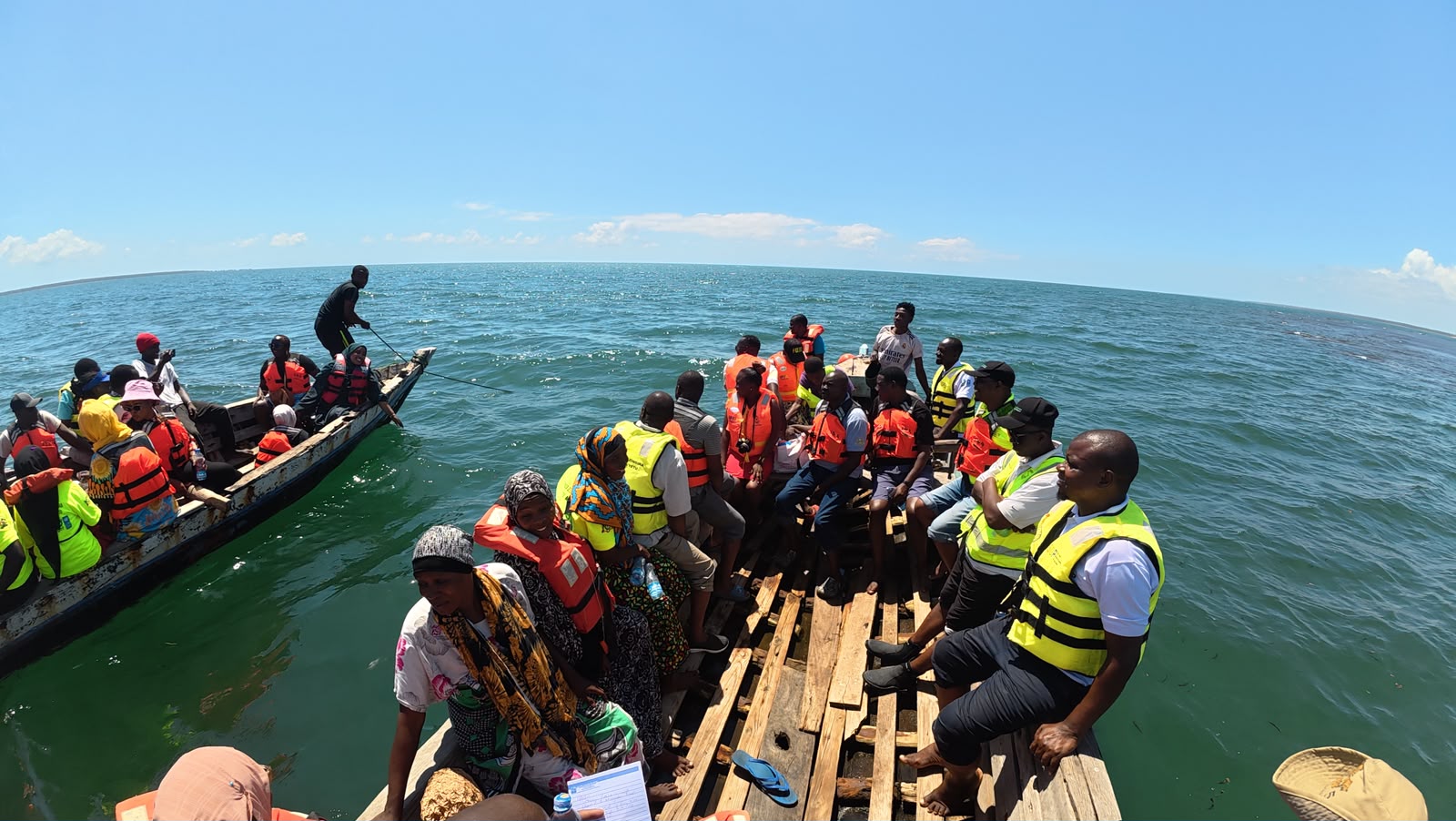
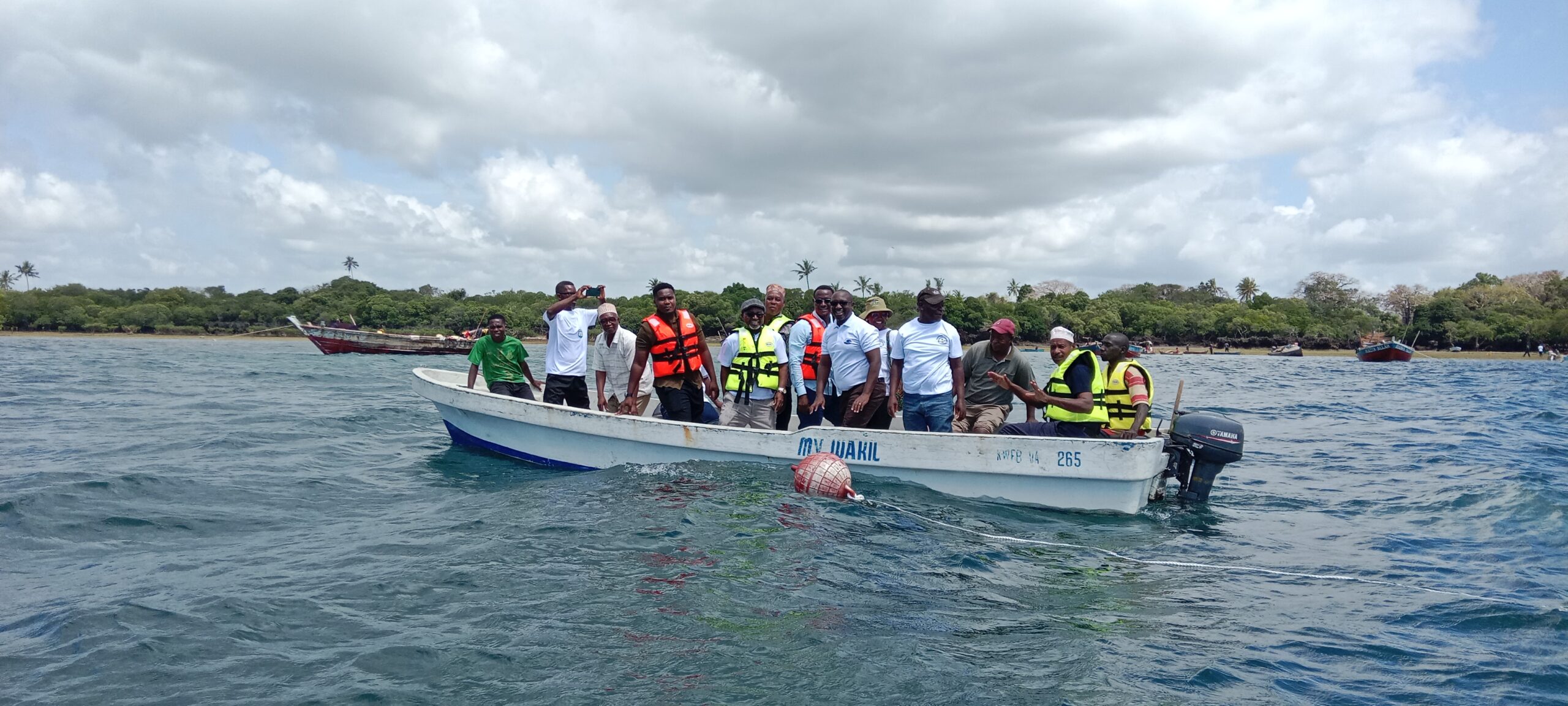
The team from Coastal and Marine Resource Development (COMRED), Kibuyuni BMU officials and other stakeholders demarcating the fisheries closure ahead of the official launch |Photo courtesy of COMRED
Even with the demanding responsibility of ensuring that everything went according to plan, Mohamed Jasho could hardly contain his excitement. As Chairperson of Kibuyuni Beach Management Unit (BMU), he had waited for this moment, one that marked the culmination of years of discussions, community engagement and painstaking efforts to correct mistakes of the past.
For him, it was an epic moment, a milestone that would go down in the history of Kibuyuni and the Kenya coast.
“We are excited and confident about this initiative. After years of abandonment, the community is finally relaunching our fisheries closure, breathing life into a conservation initiative that had been dormant for nearly a decade,” said Jasho.
Along the southern Kenyan coast, where the Indian Ocean sustains thousands of households through fishing, seaweed farming and other marine-related activities, the revival of the Kibuyuni fisheries closure carries significance beyond the boundaries of the small coastal community in Kwale County.
It represents a second chance for a community that has experienced both the promise and the pitfalls of community-led marine conservation.
A community whose life revolves around the ocean
Kibuyuni is one of the coastal communities in Kwale County whose economic and social activities are closely connected to the ocean. Fishing is a major livelihood, with the surrounding waters supporting fishers, fish traders, dealers and processors who depend on daily catches for their incomes.

Kibuyuni’s connection to the ocean is therefore not limited to the fish landed on its shores. It encompasses a network of economic activities involving seaweed farmers, fishers, fishmongers, traders and other small-scale enterprises.
It is against this backdrop that the revival of the fisheries closure assumes greater importance.
Learning from a failed experiment
According to Dr Patrick Kimani, Coastal and Marine Resource Development (COMRED) Director, the process of establishing the initial closure, which began around 2015 and operated until 2018, encountered challenges that eventually led to its collapse.
The experience, he said, exposed weaknesses in community governance, enforcement and participation, offering important lessons about what can undermine otherwise promising conservation initiatives.
Rather than abandoning the idea altogether, the community and its conservation partners have embarked on a process of rebuilding the initiative, this time with greater attention to the institutional and governance arrangements that will determine its sustainability.
“For us, the revival of the Kibuyuni fisheries closure has been a journey that demonstrates the resilience of the community,” said Dr Kimani.
He explained that the renewed process involved extensive awareness creation, reaching more than 500 people in Kibuyuni and the surrounding five landing sites served by the BMU.
“There was also a review of the governance framework, including the closure’s by-laws, obtaining community consent and developing mechanisms for sharing benefits generated through activities such as ecotourism.
“The process has also benefited from stronger government involvement, particularly through the Joint Co-Management Areas (JCMA) framework, which provides an institutional and legal basis for collaborative fisheries management,” he added.

Dr Kimani said the revival is contributing to wider national and international biodiversity conservation commitments, including the Convention on Biological Diversity (CBD) targets and the recognition of other effective area-based conservation measures.
But beyond policy commitments and conservation targets, the real test will be whether the community can protect the closure and sustain its benefits.
Confronting the mistakes of the past
For Mohamed Mwasare, Secretary of Kibuyuni BMU, understanding why the previous closure failed was the starting point for the revival.
He recalled that the earlier management arrangement was undermined by several governance and operational weaknesses.
One of the biggest challenges was the inability to conduct effective patrols. Community members tasked with monitoring the closure lacked adequate training, making it difficult to detect and respond to illegal fishing activities.
“Enforcement was equally weak. Fishers found violating the closure’s regulations were often not held accountable, with family relationships and political connections sometimes influencing how cases were handled.
“There were also allegations of misconduct within the BMU leadership itself, with some officials reportedly fishing secretly inside the closure at night,” said Mwasare.
These incidents eroded public confidence and made it increasingly difficult to persuade ordinary fishers to respect the restrictions.
Perhaps most importantly, he said, the wider community had not fully understood the purpose of the closure or appreciated how it could benefit them.

The absence of an inclusive benefit-sharing arrangement further weakened community support.
“When the new BMU officials assumed office, we met with COMRED and started discussing the reasons that led to the collapse. One of the biggest issues that emerged was the lack of community involvement,” said Mwasare.
The BMU, working with COMRED and other partners, embarked on an extensive community sensitisation campaign.
Meetings were organised across the five landing sites, bringing together different groups of marine resource users to explain the purpose of the closure, its expected benefits and the importance of collective responsibility.
The campaign reached 579 people, including fishers and other stakeholders whose livelihoods are linked to the marine environment.
The BMU also began addressing the issue of alternative livelihoods, recognising that increasing numbers of fishers and pressure on marine resources require solutions that go beyond restricting access to fishing grounds.
Following the awareness campaign, the community proceeded with mapping and demarcating the closure, installing moorings to make its boundaries visible and help visiting fishers avoid entering the protected area.
Rebuilding trust and community ownership
Dr Joseph Tunje, COMRED Director, said for them the relaunch represents the outcome of a collaborative process aimed at addressing the weaknesses that undermined the original closure.
“Working alongside GIZ, Blue Ventures, Kibuyuni BMU, the Kenya Fisheries Service (KeFS), the Kwale County Fisheries Department and other conservation partners, COMRED has supported the community in rebuilding the governance and operational structures needed to manage the closure.
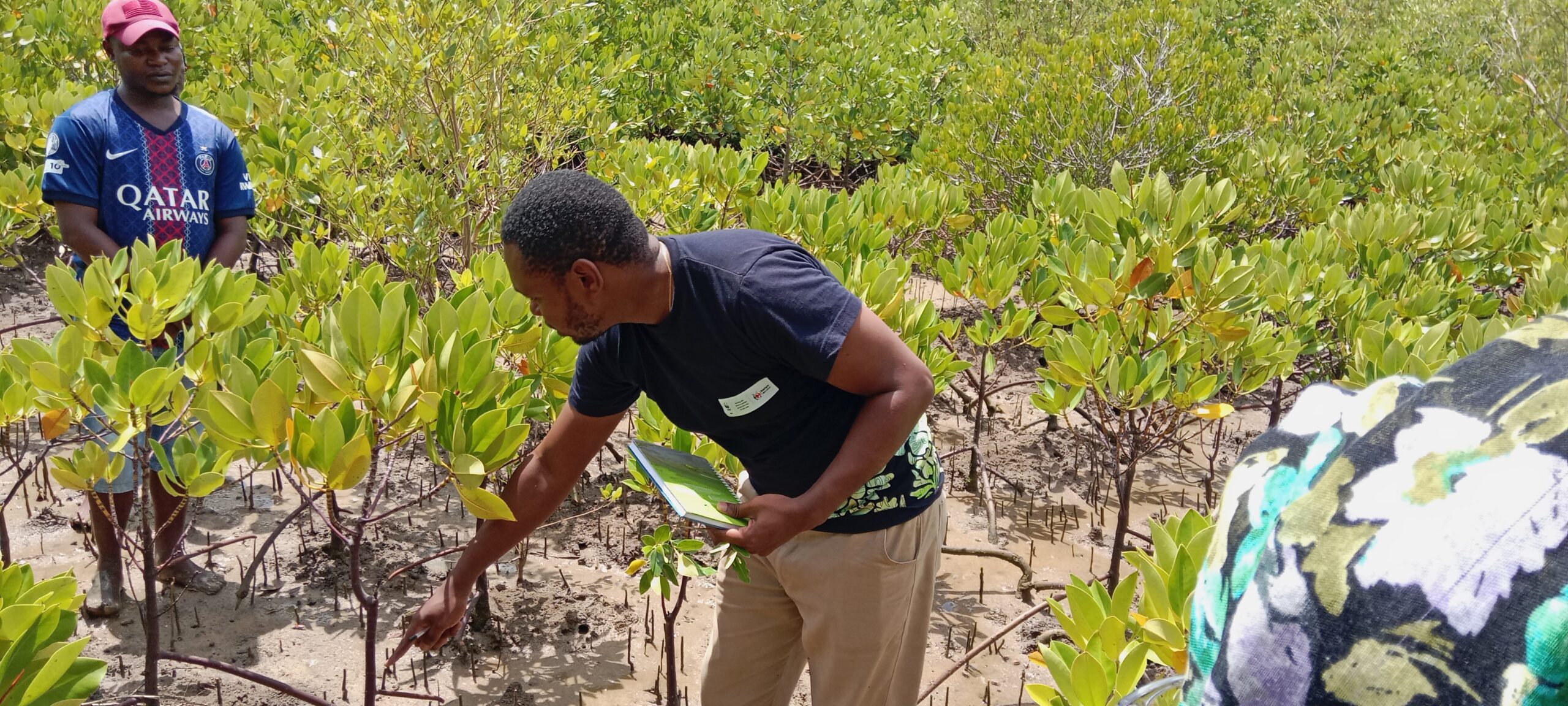
“The interventions have included community awareness, reviewing by-laws, developing an action plan, training community members in patrol operations and ecological monitoring, and supporting the mapping and demarcation of the closure,” he said.
The organisation has also emphasised the importance of transparency and accountability in managing the closure and ensuring that benefits are shared fairly.
The Kwale County Director of Fisheries, Mbarak Mapapa, echoed this position, emphasising that communities must understand and experience the benefits of fisheries closures if they are to take responsibility for protecting them.

“The community must be able to understand the benefits from fisheries closures, but most importantly, they should be involved at every step, including benefits sharing. They must feel the impact in order for them to take responsibility,” he said.
He added that fisheries closures are now guided through the Joint Co-Management Areas framework, providing a legal basis for their protection and making violations punishable.
“The strengthened regulatory framework is expected to address some of the enforcement gaps that contributed to the collapse of the earlier initiative,” said Mapapa.
An old conservation practice with renewed relevance
Although fisheries closures are increasingly being promoted as a modern fisheries management intervention, Halifu Omar, Chairperson of Shimoni BMU and Chair of the Shimoni-Vanga Joint Co-Management Area, points out that the concept is not entirely new to coastal communities.
Traditionally, communities observed areas where fishing was restricted to allow fish populations to reproduce and marine resources to recover.
These customary conservation practices were based on an understanding that fishing grounds needed periods of rest if they were to continue supporting livelihoods.
For Omar, the Kibuyuni closure is therefore a continuation of an established community conservation tradition, albeit under a more structured management arrangement.
He described it as a national asset whose benefits extend beyond Kibuyuni, given the interconnected nature of marine ecosystems and the importance of collective action in safeguarding fisheries resources.
The real work begins after the launch
While the relaunch is a major achievement, those involved in the process acknowledge that the real work lies ahead.

The next phase will involve putting in place consistent patrols, collecting fisheries data and monitoring changes in the ecological condition of the closure.
According to Dr Kimani, the monitoring programme will include fisheries catch data collection and ecological assessments to establish whether the closure is delivering the intended conservation outcomes.
The information will also be shared with the community to demonstrate progress and sustain public support.
Such monitoring is critical in determining whether the closure is contributing to improved fish populations, habitat recovery and better fisheries outcomes.
It will also help establish whether the conservation intervention is generating tangible benefits for the community, including through ecotourism and other livelihood opportunities.
For Kibuyuni BMU, the challenge will be to ensure that the mistakes of the past are not repeated. This means conducting regular patrols, enforcing regulations fairly, maintaining transparency in leadership and ensuring that no individual or group is allowed to undermine the rules.
The BMU chairperson said the revival process deliberately brought together fishers, seaweed farmers, fish dealers, fishmongers and other stakeholders because they all have a stake in the sustainability of marine resources.
“This inclusive approach is particularly important in a community where conservation decisions can have implications for different economic activities and household incomes,” said Jasho.

A model for other coastal communities?
Beyond Kibuyuni, the experience is already offering lessons to other communities interested in establishing or reviving their own fisheries closures.
Dr Kimani said the lessons drawn from the Munje octopus closure and the Kibuyuni experience will inform similar initiatives elsewhere along the coast.
Funzi and Shimoni BMUs are among the communities that have expressed interest in establishing their own closures.
The intention is to use the experiences gained, including the mistakes and shortcomings of previous initiatives, to develop more effective community-led conservation models.